




A Decade of Teaching Excellence: Inside 10 Years of Westcliff’s LITE Center
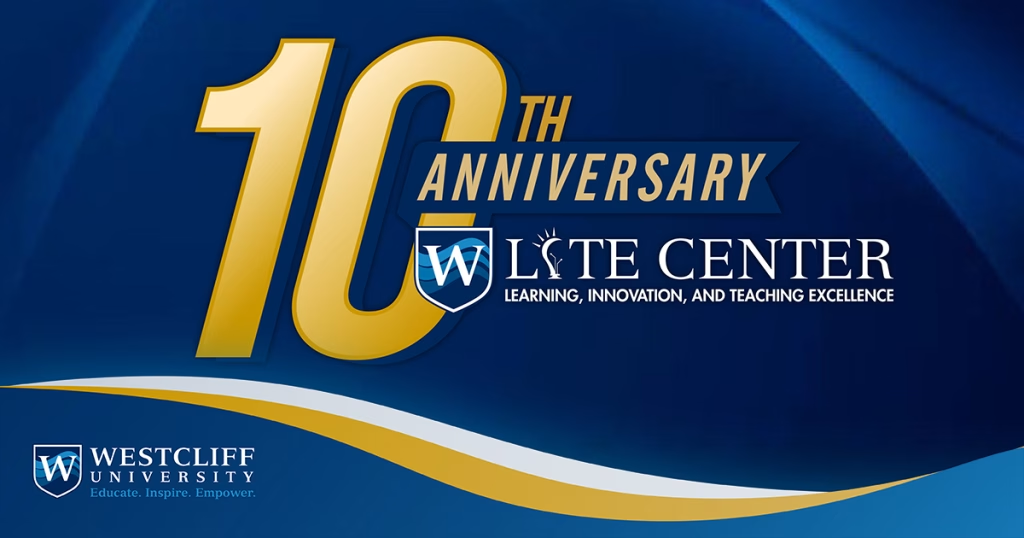
Ten years ago, Westcliff University set out to address a common challenge in higher education: how to support subject-matter experts in becoming effective educators.
That effort became the Learning Innovation & Teaching Excellence (LITE) Center.
A decade later, the LITE Center plays a central role in how teaching is designed, delivered and improved across the university. It supports faculty at every stage, shaping both instruction and the student experience. At its core, the work has always focused on connecting subject-matter expertise with effective teaching practices.
“What the LITE Center set out to do was bridge the gap between expertise and teaching excellence,” said Dr. Diana Siganoff, senior director of faculty affairs at Westcliff University. “It gave faculty practical support and a real sense of community that carries directly into the student experience.”
That foundation continues to guide how the center supports faculty today, as teaching evolves and expectations around learning continue to grow.
How Has the LITE Center Evolved Over the Past 10 Years?
As higher education has changed, LITE has adapted alongside it.
Faculty are now teaching across online, hybrid and in-person formats, often working with students from a wide range of backgrounds. At the same time, expectations around engagement, outcomes and career readiness have continued to grow.
“The original vision for the LITE Center was really to create a home for faculty development,” said Dr. Siganoff. “It’s a place where faculty feel supported, inspired and equipped to grow in their role as educators.”
In response, LITE expanded beyond traditional training and moved toward a more comprehensive model of support.
“One of the biggest shifts for us was when we stopped thinking about just training and started thinking more holistically about the faculty experience,” Siganoff said.
This shift positioned LITE as a partner in teaching, helping faculty navigate change while maintaining a focus on effective, student-centered instruction.
What Support Does the LITE Center Provide for Faculty?
Today, the LITE Center offers a range of resources designed to support faculty in practical, day-to-day teaching.
This includes:
- Instructional design support
- Active and student-centered teaching strategies
- Faculty development workshops and webinars
- Mentorship and peer collaboration opportunities
“We’re offering practical guidance,” Siganoff said. “Helping with course design, active learning and student-centered teaching.”
Beyond individual resources, the center takes a structured approach to faculty development, supporting educators from onboarding through ongoing growth. Faculty have access to programming that is intentionally designed to be flexible, relevant and aligned with the realities of teaching across different formats and student populations.
The ultimate goal is to ensure faculty have access to tools and strategies they can apply directly in the classroom—support that is not only theoretical, but immediately applicable.
Key Moments From the Past Decade
Some of the most defining moments for the LITE Center didn’t come from planned initiatives, but from how it responded to faculty needs in real time.
For Dr. Siganoff, one of the most meaningful turning points came after building out extensive training programs and hearing a consistent message from faculty.
“We built a whole slew of the most amazing content – three-hour training, five-hour training, eight-hour training, 16-week training — it didn’t matter what you wanted, we had it,” she said. “We’ve created a space where faculty can adapt and try things, really grow with confidence, instead of feeling like they’re navigating all of this alone.”
That shift toward more practical, flexible support became a defining moment in how LITE approaches faculty development today.
How Does the LITE Center Support Teaching Innovation and AI?
As artificial intelligence continues to reshape higher education, LITE has taken an active role in helping faculty understand not just how to use these tools, but how to use them responsibly.
Key areas of focus include:
- Practical AI training: Guidance on emerging tools like ChatGPT, along with how they can be applied in real classroom settings
- Academic integrity and assessment: Helping faculty rethink how learning is evaluated in an AI-supported environment
- Responsible AI use: Emphasizing thoughtful, intentional integration rather than over-reliance on technology
- Faculty confidence and adoption: Supporting instructors as they navigate uncertainty, reduce hesitation and experiment with new tools
- Student-centered application: Encouraging students to use AI to refine ideas, explore concepts and support research while maintaining ownership of their work
“We’re not going to allow AI to replace learning,” Siganoff said. “But we are going to allow AI to enhance it.”
In the classroom, that translates into a more intentional use of AI. Students are encouraged to use it to refine ideas, explore concepts and support research while maintaining ownership of their work and understanding of the material.
“We need to make sure that however we use AI, it’s really centered on learning,” Siganoff said. “Don’t chase technology just for the sake of technology.”
How Does the LITE Center Improve Student Learning and the Classroom Experience?
The impact of LITE is most visible in the classroom.
By supporting faculty development, the center influences how courses are taught and how students experience learning. Faculty are better equipped to design engaging courses, lead discussions and respond to student needs, creating a more interactive and supportive environment.
“What LITE is doing is making faculty development real,” Siganoff said. “It’s practical, accessible and relevant.”
As faculty grow more confident and connected, that carries into their teaching.
“They’re more confident in what they’re doing,” Siganoff said. “They’re more connected to one another, and that shows up in the classroom.”
For students, that shift changes how learning happens. Rather than passively receiving information, students are encouraged to apply concepts, participate in discussions and connect coursework to real-world goals.
In many cases, that learning translates immediately, with students applying what they learn in class to their work, reinforcing a stronger link between academic instruction and career readiness.
What’s Next for the LITE Center at Westcliff University?
As the LITE Center enters its next decade, its focus remains on supporting faculty while preparing students for a changing workforce.
Advances in AI, evolving industry needs and new approaches to teaching will continue to shape how education is delivered. LITE is expected to play a key role in helping faculty adapt while maintaining a strong focus on learning outcomes and academic rigor.
“That is creating opportunities for our students to prepare themselves for jobs that don’t even exist yet,” Siganoff said. “And that’s incredibly exciting.”
Ten years in, the LITE Center reflects an ongoing investment in faculty development and student success. By supporting educators as they grow and adapt, it helps ensure that teaching at Westcliff remains relevant, practical and aligned with the needs of today’s students.
As higher education continues to evolve, that foundation will remain essential.