





What Teachers Week Revealed About Two of the Most Inspiring Faces Behind Westcliff’s College of Nursing
Every year, Teachers Appreciation Week comes and goes with a few kind words and maybe a card or two. At Westcliff University’s College of Nursing, it means something more deliberate than that. It is a moment to stop and actually look at the people standing at the front of the classroom, the ones who show up prepared, passionate and fully invested in students who are chasing something bigger than a degree.
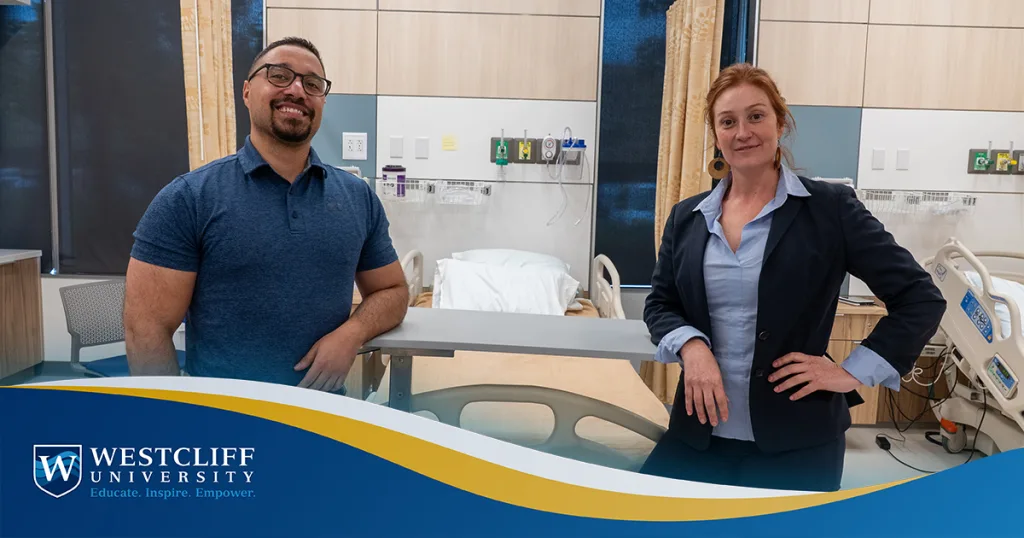
Tarah Lehman, an adjunct instructor in the College of Nursing’s general education science program, brings the human body to life for students in her anatomy and physiology courses. Omar Muneeb, who teaches chemistry and college algebra in the same program, does the same for two subjects that can make or break a nursing student’s confidence before they ever set foot in a clinical setting.
Between them, they carry decades of lived experience that have nothing to do with a traditional teaching resume and everything to do with why their students keep coming back. One ran a holistic health center in Portland, spent 10 years in the Alaskan wilderness and enrolled in medical school in the Caribbean.
The other was a self-described introvert and published research chemist who walked into a classroom for the first time on a dare and never looked back.
What they found on the other side of those journeys was the same thing: a calling they did not see coming and a conviction that the students sitting in front of them deserve every bit of.
What Inspires Westcliff Faculty Members to Become Educators?
Lehman didn’t grow up with a roadmap. As a first-generation college student raised in a blue-collar household, nobody in her family had navigated higher education before her. But a high school athletic trainer who saw something in her created a private one-on-one class just for her, lighting a fire that never went out and eventually sent her down a path she never could have predicted.
“From that, I realized I didn’t know anything. And I was like, I want to know everything,” Lehman said. “I’m a first-generation college student, so I was really navigating everything myself. I went through psychology, manual therapy and I owned a business. And then when I started teaching, I was working with people who were working for more than a bottom line. They were working to better their lives. That gave me all the perspective I needed.”
Muneeb’s turning point was quieter but just as decisive. Midway through his master’s program at California State University, Fullerton, he took a graduate teaching assistant position not because he felt ready but because he wanted to find out if he could handle it. What happened in that first semester rewired everything.
“When I first taught, it was a feeling that I couldn’t explain, a form of satisfaction that I had never experienced in my life,” Muneeb said. “I’ve been teaching now for 10 years and to this day I still chase that feeling every single time I teach. I wanted to go into research and development until I started teaching and that changed my entire career path.”
What Does it Actually Take to Be a Good Nursing Professor?
Ask either of them what people misunderstand about teaching and the answer comes fast: most people have no idea how much work happens before a single student walks through the door.
Lehman describes it as intellectual performance, the kind that demands total presence for the entire duration of a class on top of hours of preparation that students rarely see or think about.
“You have to be on. You have to know exactly how to respond no matter what field the questions come from. You are intellectually performing for that entire time,” she said. “But on top of that, there’s the preparation to make it accessible for the students, to make it understandable. It can very easily look polished and easy, but that’s what we work so hard to make it feel like, because everything we put in happens on the back side.”
Muneeb argues that the invisible labor of teaching goes well beyond lecture prep. It lives in the small moments most institutions never measure: the student pulled aside after class, the office hour visits, the at-risk learner who needed someone to notice before it was too late.
“A lot of people just think that you go in, teach a course and that’s it, without realizing that a lot more goes into it when it comes to prep, designing the lectures, designing the labs, making sure that everything is flowing seamlessly from one week to the other so that each concept is building upon each other,” Muneeb said. “Some students are shy and scared to talk to you. So I try my best to go out of my way, pull them aside or meet with them after class and ask, what can I do to help you do better in this course? I believe these little things that we do as instructors should be appreciated.”
Why Should I Study Nursing at Westcliff University?
Both Lehman and Muneeb are quick to point out that the environment at Westcliff makes their work possible in a way that not every institution can claim. As Lehman puts it, there is a difference between a school that cares about enrollment numbers and one that cares about the person behind them.
“There are lots of schools and institutions that really care more about a bottom line, but here they really care about you,” she said. “I really care about you. My colleague Omar [Muneeb] really cares about you. And that richness of background that students bring into nursing is really incredible, because empathy comes from everywhere and you can understand patients so much better if you have different insight.”
Muneeb points to Westcliff’s leadership as proof that the culture runs deeper than good intentions.
“Our leadership here does an amazing job at recognizing faculty members. They even send out announcements recognizing how valuable faculty are and how they want to celebrate your accomplishments,” he said. “That is the beauty of teaching here. It makes me very happy to do what I do at this institution.”
Why Does Having a Good Teacher Matter in Nursing School?
Great teaching travels with every student who walks out the door, into hospitals, into communities and into the lives of the patients they will one day serve. Lehman, who navigated her own academic path without a mentor and felt the weight of that firsthand, is determined to be something different for her students.
“I read data showing that if someone made a connection with a teacher in their undergrad, you could exponentially see their growth in their field just from having that one connection,” she said. “I want to be able to say, hey, here are your options. Did you know these paths exist for you? Did you know you don’t have to go this way, you can go this way instead? You don’t know what you don’t know until you know you don’t know it. That mentoring is so important.”
Teachers Appreciation Week is one week on the calendar.
But for students at Westcliff’s College of Nursing, the impact of faculty like Tarah Lehman and Omar Muneeb is something they will carry into every shift, every patient room and every moment that calls on them to be more than technically prepared. It calls on them to care. And that, their teachers will tell you, is exactly the point.