





Westcliff SMART™ Students Build ELEV8, an AI-Powered Platform for Faculty Development

When SMART™ students are handed a real institutional challenge, the result can be bigger than a class project.
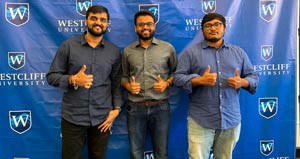
In just eight weeks, MBA students Matthew Panzica, Jalaludeen Noorul Jasmine, Amol Gaikwad and Mursal Sikandary developed ELEV8, an AI-powered faculty development platform created through Westcliff University’s SMART™ program and led by Dr. Sanaz Tehrani, assistant professor in the College of Business.
The platform was presented during the team’s final SMART™ showcase, where students demonstrated how ELEV8 could centralize professional development resources, support structured faculty learning pathways and give academic leaders stronger insight into faculty growth.
Panzica said the team began with a clear problem to solve: Westcliff needed a more effective way to help faculty access development resources and track progress.
“Before ELEV8, there was another system that didn’t really work for Westcliff’s needs anymore,” Panzica said. “The system was very outdated and hard for faculty to use. With the vision for ELEV8 over the past eight weeks, our team worked to find a solution that would make it easier for users to find materials, follow learning paths and track progress.”
That solution quickly became a strong example of what the SMART™ program is designed to make possible. Built by four students in less than two months, ELEV8 gave Westcliff leaders a working look at how faculty development could become more accessible, organized and data-informed across the university.
What Is ELEV8?
ELEV8 is an AI-powered faculty development platform designed to make professional growth easier to access, organize and measure.
The platform was developed as a modern alternative to ACORN, a system that no longer met Westcliff’s needs for accessibility, usability and progress tracking. During the presentation, the SMART™ team explained that faculty needed a more intuitive way to locate resources, follow development pathways and document growth over time.
ELEV8 was built around four core use cases:
- Knowledge base search
- Structured learning pathways for faculty
- AI recommendation engine
- AI teaching support chatbot
The platform also includes advanced analytics, KPI tracking, department-level reporting, faculty achievement portfolios and digital badges that can be shared on LinkedIn. Embedded learning resources, including YouTube content, are also part of the experience, helping turn professional development into a more centralized and usable system.
Jalaludeen Noorul Jasmine, who helped lead product strategy and design, said the team started with the needs of faculty, chairs and administrators.
“My job was not just to list what we should build,” Jasmine said. “It was to make sure we built the right things for the right reason in the right order. Every single feature in ELEV8 started with the problem we identified from the faculty, the chairs, the administrators. The number one complaint from faculty was simple: ‘I can’t find what I need.’ We didn’t respond with just a search. We made a decision. We set a hard benchmark: Faculty must be able to find a relevant resource within 60 seconds of logging in.”
That benchmark shaped the platform’s knowledge hub, filters, AI engine and chatbot. The team focused on building a tool that responded to real user needs rather than adding technology for the sake of it.
How Did SMART™ Students Build ELEV8 in Eight Weeks?
The project came together through Westcliff’s SMART™ program, where students tackle real business and institutional challenges through applied learning, functional requirements gathering and industry-aligned project management practices.
Each student contributed to a different part of the project. Panzica focused on front-end design. Jasmine helped shape product strategy and the user experience. Gaikwad supported backend development. Sikandary contributed to the platform’s buildout and delivery. The team also worked closely with Westcliff faculty and university leaders to understand what users needed from a stronger faculty development system.
The platform itself reflects that blend of strategy and execution. ELEV8 uses a modern cloud-based architecture, with a React.js front end, a Node.js backend and Firebase supporting real-time data. The project also included Firebase and PostgreSQL database design for scalable deployment, while Vercel was used for live deployment. Those details matter because they show ELEV8 was not presented as a static concept. It was built, tested and deployed as a live platform.
Panzica said the project pushed him to learn new tools and grow through the process.
“I didn’t know how to use Figma,” Panzica said. “I was like, ‘What am I doing here?’ And I learned so much. Thank you, Dr. Tehrani. Being part of this whole group, we worked together as a team. It was a lot of fun these past couple of days and weeks leading up to this presentation. I feel like I’ve learned so much in general, and I’ll take it for sure for the future and whatever may come to be.”
That growth on the student side translated into measurable results on the platform side. During user acceptance testing, the team executed 71 test cases and reported a 100% pass rate across modules and user roles. Presentation materials also highlighted a key performance benchmark: users were able to locate relevant resources within 60 seconds.
How Does ELEV8 Help Faculty and Academic Leaders?
ELEV8 gives faculty a centralized place to search resources, follow development pathways, receive AI-powered recommendations and ask teaching-related questions through a chatbot.
Its recommendation engine uses a weighted multi-signal scoring model to personalize suggestions based on user goals, interests, skill level and activity patterns. That gives faculty a more tailored experience while still allowing the institution to guide how recommendations are prioritized. The chatbot adds another layer of support by helping users find information through natural language interaction rather than relying only on manual search.
The platform also gives department chairs and administrators better visibility into faculty development. Chairs can review pathway progress, monitor completion, access faculty achievement portfolios and identify badges earned through completed pathways. Faculty can also share those badges on LinkedIn, giving professional development a more visible and portable form of recognition. Administrators can oversee content, permissions, analytics, governance workflows and reporting from a centralized dashboard.
Jasmine said the platform’s separate portals were built with governance in mind.
“These portals aren’t just different menus,” Jasmine said. “Role enforcement happens at the database level. A faculty credential cannot read chair or admin data. That was a security and governance decision.”
That structure is one of the platform’s biggest strengths. ELEV8 is organized around three distinct user roles — faculty, chair and admin — with clear separation between what each group can access and manage. That role-based design supports security, accountability and a more functional workflow across the system.
Why Did ELEV8 Stand Out to Westcliff Leaders?
Westcliff leaders praised the SMART™ team for turning an early project scope into a platform with interface design, data functions, communication tools and badging capabilities already built into the experience.
Joanie Mitchell, Westcliff professional development specialist, said the students consistently used stakeholder feedback to strengthen the platform throughout the eight-week project.
“I remember that document that you sent me, and I was like, ‘OK, sign this for the LITE Center. This is our scope of work. This is what we’re going to do,’” Mitchell said. “And I looked at it and I looked at Thomas and I said, ‘Well, let’s see what they can do.’ And Matthew, week after week, these updates, you have taken everything from that little video I sent about ACORN to all of my notes every week. Jasmine and Mursal, just really amazing work from you all, and I’m just so grateful and so excited to see where this is going to go.”
Dr. Diana Signaoff, Westcliff senior director of Faculty Affairs, echoed that reaction and described the presentation as far beyond the original expectations for the project.
“The students have built the Empire State, and I am not overstating that,” Dr. Signaoff said. “I am shocked. I’m absolutely flabbergasted at what they have been able to achieve, the quality of what they have been able to achieve and how every single question that I had planned to ask, they covered in the presentation. I have never seen anything at this standard at a university in my entire career.”
Their comments underscored one of the biggest takeaways from the showcase. The students did more than respond to feedback. They built a platform that addressed long-standing faculty development needs in a practical, visible and potentially scalable way.
What Could ELEV8 Mean for Westcliff’s Academic Future?
Academic leaders also saw potential for ELEV8 beyond its initial faculty development purpose.
Dr. Jorge Cardenas, Westcliff’s dean of the College of Business, said the platform stood out from an information systems perspective.
“I’m just blown away by what this could mean for our institution,” Dr. Cardenas said. “I have a background in information systems, and the ability for you guys to design this platform in eight weeks is astonishing. I’m sure that we will be able to leverage this within academic affairs and also in other parts of the institution.”
Dr. Yuki Mun, MBA program chair in the College of Business, described ELEV8 as a potential faculty learning management system.
“This is really great because we’ve been seeing learning management systems and student-first systems. Why not faculty learning management systems?” Dr. Mun said. “The potential is huge. It doesn’t just have to be limited to faculty. It can actually expand even to staff. Within eight weeks, this team could build this. It is really, really amazing.”
Those reactions point to a larger opportunity. Although ELEV8 was built around faculty development, its structure could eventually support broader professional learning, institutional reporting and future integrations with platforms such as Canvas, Blackboard and Moodle.
What Comes Next for ELEV8?
ELEV8 is now moving into a new phase of discussion. Westcliff leaders mentioned continued backend planning, technical review and future deployment considerations.
The platform is also expected to be featured at the Global Faculty Summit, a gathering of faculty and academic leaders from around the world focused on AI, the joy of learning and the future of human-centered education. Designed as a collaborative space, the summit will include breakout sessions centered on four key pillars, along with student focus groups and an interactive panel that brings together student and faculty perspectives on AI, teaching and learning in higher education.
The SMART™ team will take part in that conversation as a panel, sharing how they applied AI throughout the program and how that work led to the development of ELEV8. Their participation places the project in a broader academic dialogue about innovation, institutional responsibility and the future of learning.
The final SMART™ showcase marked an important milestone for the student team and the university. In eight weeks, four students built a live deployed platform that could help Westcliff make faculty development more accessible, measurable and responsive to real institutional needs.
ELEV8 also showed what the SMART™ program can make possible when students are given a meaningful challenge, strong mentorship and a clear opportunity to build something that matters.