



Westcliff Nursing Students Show Readiness in High-Stakes Clinical Settings
Clinical rotations mark the point where nursing education shifts from theory to practice. They also show how students respond when learning moves out of the classroom and into active patient care. At Westcliff University’s College of Nursing, those experiences are already revealing the awareness, professionalism and clinical judgment students are beginning to bring into the field.
Sahara Aguilar, Westcliff College of Nursing adjunct faculty, M/S, Gero, Peds, PH, said clinicals give students a chance to apply what they have learned in situations that demand focus, communication and accountability.
“Clinical rotations are the practical, hands-on portion of the curriculum. This is where students step out of the classroom and into live health care settings,” Aguilar said. “It is a vital bridge because students are taking their textbook knowledge and bringing it into real patient care. On the unit, they are fully immersed with the health care team. They participate in patient handoff, practice their SBAR communication skills, obtain vital signs and take part in the medication administration process while caring for patients in real time.”
That transition is what makes clinical education so important. It is also where Westcliff students are beginning to stand out. In moments that require close observation and quick decisions, they are stepping into the kind of responsibilities that define the profession.
What are Westcliff nursing students doing in clinical settings that stands out?
Some of the most important moments in clinical care do not begin in an obvious crisis, but in a student’s ability to notice when something is not right.
Aguilar recalled a night shift when a student was completing routine rounds and checking vital signs. During that process, the student noticed a patient had removed their oxygen support and identified that the oxygen saturation had dropped to 60 percent. The student immediately escalated the situation to the primary nurse and charge nurse, which led to a rapid response from the broader care team.
“Later on that evening, the nurse actually told us if my nursing student had not been doing rounds in the middle of the night, they would have found that patient in a full-blown crisis,” Aguilar said. “That desaturation in oxygen could lead to death. It was at the end of the shift that they realized no one else could have caught that at that moment and they were thankful they were there at the right place at the right time.”
That moment matters because it reflects the kind of judgment nursing students have to develop early. The student was not reacting to an obvious emergency that had already unfolded. They recognized a serious change during a routine task, trusted what they were seeing and acted quickly enough to help prevent a much worse outcome.
Aguilar said that is exactly what clinical training is meant to build. Students are learning how to stay alert, communicate clearly and take appropriate action when patient safety is on the line. Those are central skills in nursing.
What other clinical moments show how Westcliff students are developing as nurses?
The standout moments during clinicals did not stop with one life-saving intervention. Other examples from this term show students stepping up in very different kinds of situations, each requiring a different level of focus and care.
- One student helped de-escalate a patient in psychiatric distress, showing calm communication and composure in a high-pressure moment.
- Another student assessed and provided wound care for a patient with myiasis, stepping into a complex case that required both clinical focus and professionalism.
Those moments show that students are not only learning procedures. They are also learning how to respond to discomfort, uncertainty and high-stakes patient interactions with steadiness and sound judgment.
“Our nursing students are using clinical judgment. They are prepared, they are out there and they are using all their theoretical knowledge, connecting the dots and putting it all together,” Aguilar said.
How are Westcliff students gaining confidence while caring for real patients?
Clinical growth is not built through one standout moment alone. It develops through repeated exposure to patient care, where students begin turning preparation into practice under faculty supervision.
Brianna Valenciano, an Entry-Level Master’s student, described what that shift has looked like in the emergency department. About seven months into the program, she found herself carrying out procedures and responsibilities that made the pace and demands of nursing feel real very quickly.
“A lot of us have been working in the emergency department for most nights,” Valenciano said. “From my experience, I was able to do a Foley catheter insertion, several IVs, injections, medication passing and wound cleaning. It was my very first time with actual patient care experience, and it has been great. We did not really get to start off easy. They kind of just threw us in there, and it has been amazing.”
Her experience offers a clearer picture of what that hands-on learning can involve:
- Foley catheter insertion
- IVs
- Injections
- Medication passing
- Wound cleaning
That kind of exposure matters because it moves students beyond observation. It places them in real care environments where they have to stay composed, apply technical skills and learn how to function as part of a larger team. The confidence students build in those settings does not come from being told they are ready. It comes from doing the work.
Valenciano also credited Aguilar with helping students feel supported enough to keep learning in those high-pressure settings.
“Professor Aguilar is amazing. She instills confidence in all of us, especially in our clinical practice,” Valenciano said. “She is very motivating. She makes us feel confident in whatever we do, and she makes us feel open to asking questions.”
That support carries weight in clinical education. Students can only grow if they are challenged, but they also need enough guidance to keep building skill without losing confidence.
How does Westcliff prepare nursing students and support them during clinical rotations?
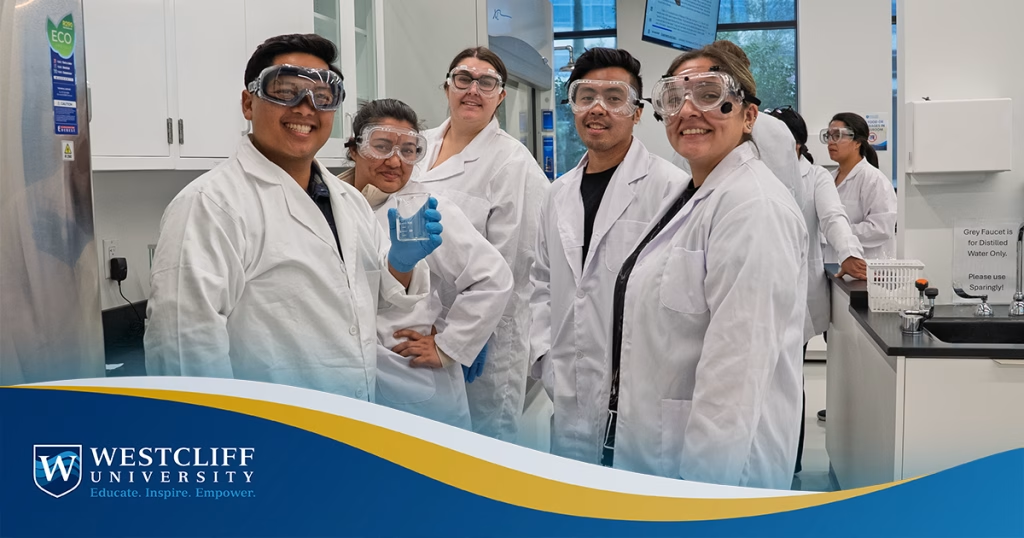
The work students are doing in clinicals begins well before they enter a hospital. At Westcliff’s College of Nursing, that preparation starts in skills labs and high-fidelity simulation, where students practice procedures, communication and decision-making before applying those skills in real patient care. Once they enter clinical settings, faculty help guide that transition and support students as the stakes become more real.
Aguilar said that preparation helps students move beyond memorization and start thinking like nurses in the moment.
“Here at Westcliff, we prepare our students in a skills lab and also high-fidelity simulation, where they are able to practice this in a safe environment,” Aguilar said. “We are not just faculty or clinical instructors – we are their mentors, their advocates, their safety net.”
Valenciano said that foundation made the move into clinicals feel more manageable.
“On campus, we have these mannequins that portray real patients, and they are actually very realistic,” Valenciano said. “They have veins, they breathe, they blink and they actually do have fake blood and fake urine. Being able to practice here definitely set us up for success in our real clinical practice.”
That combination of preparation and faculty support helps explain why Westcliff students are able to step into demanding clinical settings with growing confidence and a stronger sense of readiness.
Why does this matter for Westcliff’s College of Nursing?
These clinical experiences matter because they show what happens when preparation starts translating into real performance. They point to the kind of nurses Westcliff students are becoming while still in training.
That impact is already showing up in meaningful ways:
- Students are stepping into real responsibilities early in the program.
- They are learning how to recognize changes in patient condition and respond appropriately.
- They are applying technical skills in live care environments, not only in simulation.
- They are gaining confidence as members of a care team.
Aguilar sees those moments as part of something much larger than a single shift or semester.
“It means that I am making a difference. I am part of their career in learning and growing and developing as a nurse,” Aguilar said. “It is a legacy that you cannot teach out of a textbook.”
Taken together, these experiences point to something worth recognizing. Westcliff nursing students are already stepping into meaningful responsibilities in clinical settings. They are identifying changes in patient condition, applying technical skills and growing more confident in their ability to contribute to care teams. Those moments reflect individual effort, but they also reflect a program built to help students meet real demands with preparation, awareness and purpose.