

Shelley Spessard is Writing the AI Playbook for Tomorrow’s Teachers
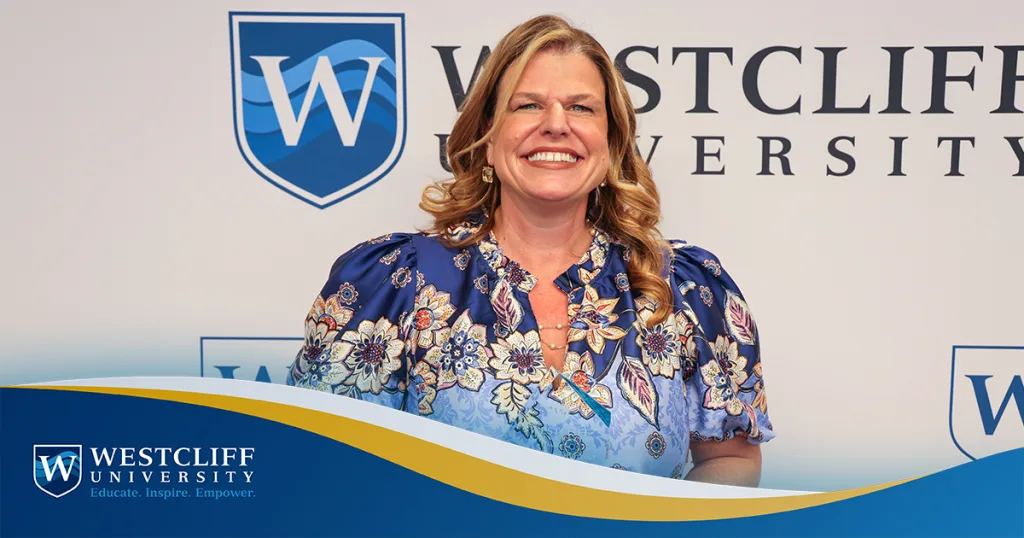
Right now, some future teacher is asking ChatGPT to help with a lesson plan and quietly wondering if that’s cheating. Shelley L. Spessard Ed.D., an adjunct faculty member in Westcliff University’s College of Education, wants her students to skip the guilt and walk into their classrooms knowing exactly how to use these tools the right way.
Dr. Spessard is a former principal and school district director who has authored two books, one focused on helping teachers integrate AI into their classrooms and another designed to help parents navigate the school system. Her combination of hands-on educational leadership experience and technological expertise earned her Westcliff’s 2026 Faculty of the Year award for the College of Education.
Her mission is to make sure no student graduates unprepared for the technology reshaping their field.
“I believe in supporting our students and working with them in using large language models, because I know they’re going to be using them in their careers,” Dr. Spessard said. “Our students are excited about it, and they should be. No student should walk away in 2026 without being fully prepared to use these tools in the workforce.”
Many professors keep their own AI use quiet, but Dr. Spessard shows students exactly how she uses it.
“I’m really transparent in my lessons. I tell them how I use large language models. I walk them through it, and I allow them to use it. We talk about the pitfalls and the ethical practices,” she said. “What I really try to do is give them relevant, real-life experiences. So when they leave our doors and walk away with that diploma, they’re set. They know how to find information, and they know how to use the tools.”
That openness matters most in the moments that make students sweat, like when a paper comes back flagged by an AI detection tool. Dr. Spessard treats it as a chance to talk things through.
“When they turn in a paper and get that high AI score, it’s the worst thing. It’s the worst thing for them, and it is for us as professors as well,” she said. “So I want that to be a conversation, a talking point where we can work together. They can use the tools ethically, but they can still use the tools.”
By the time her students run their own classrooms, they’ll have already had the tough AI conversations that plenty of teachers are still putting off.
A Classroom Where Everyone Teaches
Dr. Spessard runs her classroom more like a roundtable than a straightforward lecture hall.
“I talk to them like they’re my peers. That’s the biggest thing I really try to do,” she said. “When I go into the classroom, I’m hoping to learn more from them than I could ever teach them. So I really try to create opportunities that are relevant, so students can actually be prepared for their careers.”
She puts that philosophy to work from the very first minute. Forget the usual roll call. Dr. Spessard kicks off class by asking students what cool new tools they’ve stumbled on lately, and the first few minutes quickly turn into a tech swap meet.
The swap meet works because nobody in the room pretends to have it all figured out, Dr. Spessard included. Mistakes are expected, and her students know they’re navigating this new territory together. When the tools change every few months, that kind of shared learning keeps the whole class a step ahead.
That same spirit follows her well beyond Westcliff. Dr. Spessard wrote “The AI Playbook: 33 Winning Plays for Teachers” as a quick-start toolkit for K-12 educators, followed by “The AI Playbook for Parents: 33 Prompts to Help You Navigate the School System.” She’s even turned that learning-together approach into published work, teaming up with students from Westcliff’s online college to co-author three book chapters on AI in teaching and learning, with more on the way.
Retirement? Not on Her Syllabus
Dr. Spessard’s love of teaching formed in an unexpected seat, as a young mom volunteering in her children’s classrooms.
“I was a very young mom when my two children went to school. I went right alongside them and volunteered in the classroom, and that’s when I really found my love for education,” she said. “Once I got the bug, I decided to go back and get my teaching credential, which was an awesome journey.”
That credential launched more than 20 years in preschool through 12th grade education. She taught general and special education before moving into administration, eventually serving as a principal and later as director of student achievement and support for an Orange County school district.
She semi-retired in 2023, but the break didn’t last long.
“One day I got a message in my LinkedIn inbox from Westcliff. They were looking for faculty for the College of Education, so I took a leap of faith and applied,” she said. “I feel like my journey’s come full circle. Serving in higher ed, I’m able to reach future educators and support them so they can truly be prepared to help their own students meet their potential. This is the work that needs to be done to have the biggest influence on education systems.”
Today she teaches in Westcliff’s online college and dissertation program and mentors fellow faculty members, preparing the teachers who will guide the next generation.
Doctorate Without Borders
Some of Dr. Spessard’s proudest moments come from the dissertation side of her work, where she guides doctoral students from around the world through the biggest research projects of their academic careers. That role put her at the center of a university milestone.
Westcliff built its Doctoral Research Project (DRP) pathway for students who want to solve real-world problems through applied research, and Dr. Spessard served as dissertation chair for the very first student to go through it. An education leader from overseas, he completed it in May 2026.
“We had been building out this amazing opportunity for students, and I got to be the first to guide one of our students through that process. We were both going through it for the first time, so we were able to find pain points and make adjustments to the course and the design of the project,” she said. “That way, every student who comes after him gets our very best.”
His research tackled a headache anyone who has studied across borders knows well, which is figuring out how an education earned in one country translates to another. Instead of stopping at a research paper, he turned his findings into a free digital platform that helps people compare education systems across all 195 UN-recognized countries.
“He was creating a tool that could make valuable, actionable change. Being able to walk alongside him and watch his vision become reality was absolutely magical,” Dr. Spessard said. “I will never forget that experience. I think it was one of the best.”
His path offers a glimpse of what the DRP can do for students drawn to applied research and innovation.
And the Award Goes to…
When her name was called at the ceremony, Dr. Spessard’s first instinct was to look around the room and make sure she’d heard it right. The walk to the stage was a blur. She had spent the event in awe of the colleagues honored before her and the glowing words their students had shared, and suddenly she was standing right alongside them.
The nominations behind the honor hit hardest. Students juggle busy lives and get flooded with surveys and forms, so knowing hers took the time to write such heartfelt messages left her deeply moved. It also confirmed something she’d believed for years about what students really want from their professors.
“What it tells me is that our students are hungry to have a voice. They’re hungry to have a passionate educator who’s there to support them, take care of them and hear their stories,” she said. “It helped validate some of those long weeks and the times when things were difficult. It showed me that the work I’m doing is working.”
Rather than treat the award as a finish line, Dr. Spessard sees it as a reminder of the standard she holds herself to every time she logs on to teach.
“Every time I show up for them, it needs to be my absolute best. It’s really rejuvenated me to keep growing as an educator, because I don’t think our learning ever stops,” she said. “So I’m going to be out there looking for the greatest tools and the greatest strategies for teaching and continuing to bring them into the classroom.”
Her students can count on that next great tool showing up in class sooner rather than later.
A Place That Feels Like Family
Family is what drew Dr. Spessard into education in the first place, and she found that same feeling at Westcliff.
“The most rewarding thing is the family-like atmosphere, and family is the most important thing to me. It’s the whole reason I went into education, to support my two children in their journey,” she said. “From the day I started at Westcliff, I’ve had so many supports wrapped around me.”
Much of that support comes from Westcliff’s Learning, Innovation and Teaching Excellence (LITE) Center, the university’s home base for faculty development and mentorship. She tries to make it to every session the center offers and credits the team there with helping her grow as an educator. A few colleagues have made an especially big impact.
“Joanie Mitchell from the LITE Center is a hidden rock star at this university. She sends me encouraging messages and always gives me opportunities to teach and lead professional development,” she said. “Anthony DeVito, my boss and mentor, goes above and beyond to connect with everyone who works with him. There’s no one like him. And Dr. Diana Siganoff has been a silent cheerleader for me, always reaching out. Those three have truly made the biggest difference here.”
After more than 22 years in education, she calls Westcliff one of the most supportive places she has ever worked. It’s the same support she now passes on to every future teacher figuring out what AI means for their own classroom.