





Duration of Status
Understanding the New Duration of Status (D/S) Rule
Please note that, due to a court injunction, implementation of the Fixed Period of Admission rule has been paused pending further court review. We will update this information as additional details become available.
In the meantime, the information provided here reflects our most current understanding of the rule. Certain provisions may change as a result of the court proceedings, and the implementation date may be revised. Until further notice, the existing regulations remain in effect.
What You Need to Know
The U.S. Department of Homeland Security (DHS) has published its final rule changing how F-1 and J-1 international students and scholars are admitted to the United States.
The rule replaces the long-standing Duration of Status (D/S) admission system with a fixed period of authorized stay and introduces several additional immigration requirements affecting certain students throughout their academic journey. The rule will become effective 60 days after publication, on September 15, 2026.
Westcliff University has been preparing for these regulatory changes throughout the federal rulemaking process. Although the new requirements represent one of the most significant changes to F-1 regulations in decades, our teams have developed procedures, resources, and advising strategies to help students successfully navigate the transition.
Our commitment remains unchanged: providing accurate guidance, individualized support, and timely communication so you can remain focused on your academic success.
What Is Changing?
For more than 30 years, most F-1 and J-1 students were admitted to the United States under Duration of Status (D/S), allowing them to remain in the country as long as they maintained their immigration status and continued making normal academic progress.
Beginning with the new rule, eligible students will instead receive a fixed period of authorized stay generally corresponding to the program end date on their Form I-20 or DS-2019, subject to the limitations established by the regulation.
Students who need additional time to complete their academic program may need to apply to U.S. Citizenship and Immigration Services (USCIS) for an Extension of Stay before their authorized stay expires.
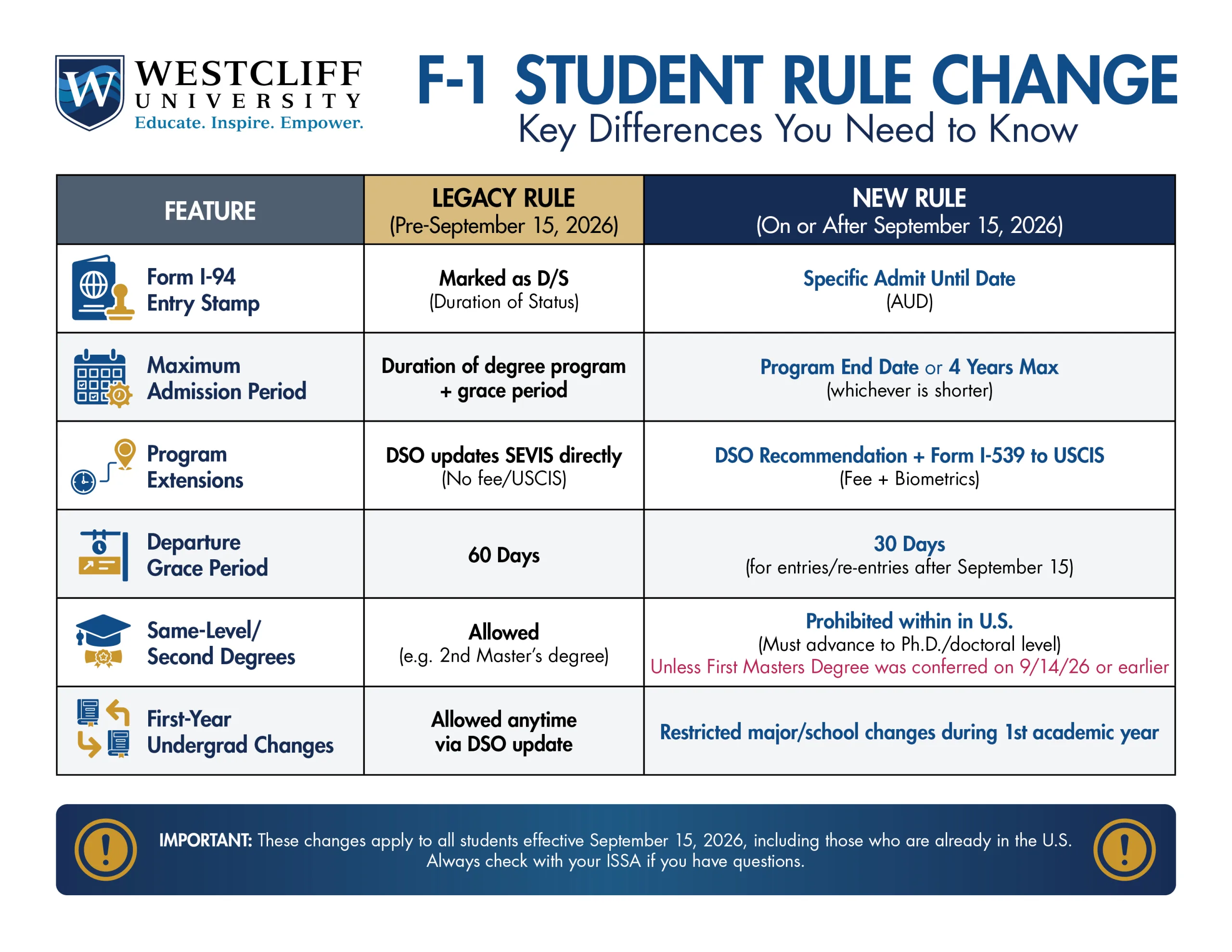
Additional Key Changes Students Should Understand
Fixed Period of Admission
Instead of remaining in the United States under Duration of Status (D/S), students will now receive a specific period of admission.
Students whose programs require additional time may need to submit an Extension of Stay application before their current period of admission expires.
Extension of Stay Requirements
Students requiring additional time to complete their program will generally need to file:
- Form I-539
- Applicable USCIS filing fees
- Supporting documentation
- Additional evidence if requested by USCIS
Because USCIS processing times can vary, advance planning will become increasingly important.
Graduate Student Transfers
Students enrolled in graduate-level programs generally will no longer be permitted to transfer to another institution to complete the same degree program.
Additional Degrees at the Same Educational Level
Most students who complete a degree at a particular educational level will no longer be eligible to pursue another degree at that same level in F-1 status.
For example, students who complete a master’s degree generally will not be eligible to begin a second master’s degree while remaining in F-1 status.
Grace Period
The post-completion grace period has been reduced from 60 days to 30 days.
Students should carefully plan for graduation, Optional Practical Training (OPT), transfers (where permitted), or departure from the United States.
English Language Programs
Students enrolled exclusively in English language training programs are subject to additional limitations, including a maximum aggregate period of study (24 months) established under the new regulation.
What Does This Mean for Current Students?
The good news is that most current students will not need to take any immediate action.
Under the final rule, students who are already in the United States in valid F-1 or J-1 status may generally remain through the expiration date already reflected on their current immigration documents. For most students, this means the program end date on their Form I-20 (or DS-2019). Students who are currently participating in OPT or STEM OPT may generally remain through the expiration date listed on their Employment Authorization Document (EAD).
As a result, most current students will not need to immediately apply for an Extension of Stay when the rule becomes effective.
An Extension of Stay generally becomes relevant only if you will need additional time beyond your currently authorized period of stay to complete your academic program.
If your academic timeline may extend beyond your current I-20 end date, or if you have questions about how the new regulations apply to your individual circumstances, International Student Services will work with you well in advance to develop an appropriate plan.
As always, every student’s situation is unique. Westcliff University will provide individualized guidance whenever additional immigration planning is necessary.
How Westcliff University Will Support You
Our commitment to international students remains unchanged.
Our International Student Services team has been preparing for these regulatory changes for many months and will continue to provide:
- Individual immigration advising
- Personalized Extension of Stay planning, when needed
- Advance reminders before important immigration deadlines
- Student workshops and informational Town Halls
- Updated guidance as DHS and USCIS issue additional implementation instructions
- Collaboration with national higher education organizations and immigration professionals to monitor emerging guidance and best practices
Our goal is to ensure every student understands what is required well before any action is needed.
What Should You Do Now?
For most students, no immediate action is required.
Continue to:
- Maintain full-time enrollment unless otherwise authorized.
- Continue making normal academic progress toward your degree.
- Keep your passport and immigration documents current.
- Monitor your Westcliff email for important updates.
- Attend upcoming immigration workshops and informational sessions.
- Contact International Student Services before making significant changes to your academic plans.
Please avoid making immigration decisions based solely on information found online or on social media. Every student’s circumstances are unique, and our advisors are here to help you understand how these new regulations apply to your specific situation.
Frequently Asked Questions
Will I lose my F-1 status because of this rule?
No. Students who continue maintaining their F-1 or J-1 status should continue following normal university procedures. If additional action becomes necessary under the new regulations, International Student Services will provide guidance well before any deadlines.
Will everyone need to file paperwork with USCIS?
No. Extension of Stay requirements depend on your individual circumstances, including your program length, admission period, and expected graduation timeline..
Should I be worried?
No. While this rule represents a significant change in federal immigration procedures, it does not change Westcliff University’s commitment to supporting international students. Our team has been preparing for these changes throughout the federal rulemaking process and is ready to help you navigate the new requirements.
Please see the Duration of Status FAQ for more information.
Questions?
We are here to help.
If you have questions about how the new regulations apply to your individual situation, please contact your International Student Success Advisor.
Together, we will help you navigate these changes and keep you on track toward achieving your educational goals.