





Westcliff Canada Student Takes Second Place at Brampton SecOps Hackathon
Turning an idea into a working cybersecurity solution in a single weekend is no small task. Doing it well enough to earn a spot on the podium makes the achievement even more impressive.
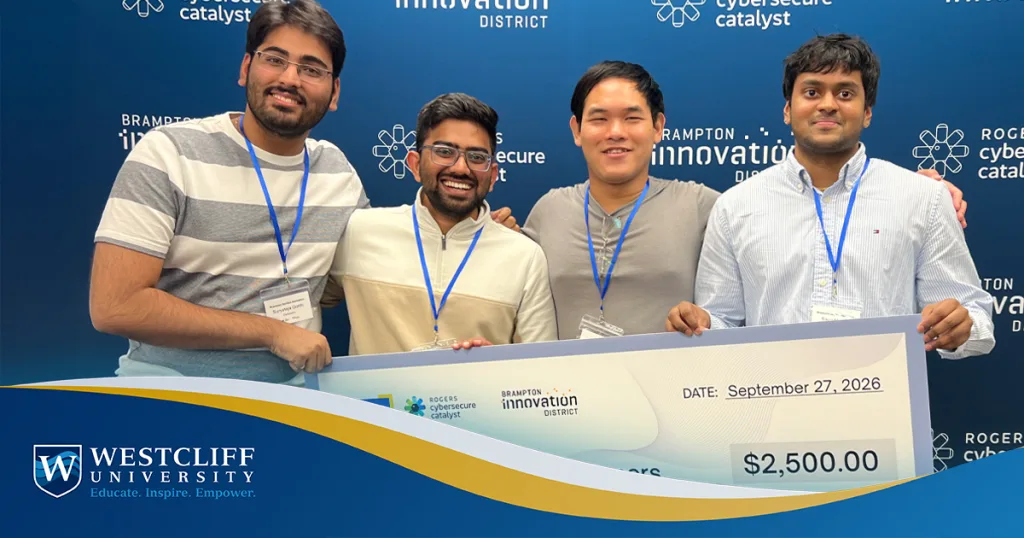
Westcliff University Canada student Kavin Mohan helped his team secure second place and a $2,500 prize at the Brampton SecOps Hackathon 2026, held September 25–27 in Brampton, Ontario.
Organized by Rogers Cybersecure Catalyst, the three-day competition challenged emerging technology talent to address cybersecurity risks facing Canada’s agri-food infrastructure and multi-modal supply chains. Participants worked alongside industry mentors and sector experts to develop practical solutions to vulnerabilities that could disrupt the movement of food and goods across the country.
Kavin and his teammates focused on the threat of fraudulent cargo pickups at logistics facilities. Their solution, TruckerTrust, uses a rotating, single-use pickup pass to add another layer of verification before cargo is released.
In just three days, the team took TruckerTrust from an initial concept to a working minimum viable product and live demonstration. Kavin played a central role in bringing the technology to life, developing much of the frontend user interface and Express backend before helping deploy the application through Vercel with a Supabase PostgreSQL database.
The process required more than technical skill. The team had to quickly understand a complex operational problem, make strategic development decisions, collaborate under pressure and clearly communicate the value of its solution to the judges. Their ability to bring all those elements together earned them second place in the competition.
From the Classroom to a Real-World Challenge
Kavin’s achievement offers a strong example of the caliber of students emerging from Westcliff University Canada and the practical education at the center of its Master of Information Systems and Technology (MIST) program.
The MIST program combines technical knowledge with strategic management and leadership development, preparing students to solve technology challenges in areas such as cybersecurity, data analytics, infrastructure management and emerging technologies. Its project-based curriculum encourages students to move beyond theory by designing solutions, working across disciplines and presenting ideas effectively to different stakeholders.
For students pursuing the program’s cybersecurity concentration, that preparation includes learning how to identify vulnerabilities, design modern security architectures and respond to evolving digital threats. Kavin’s work on TruckerTrust demonstrated how those abilities can come together to address a timely challenge with real implications for Canadian businesses and communities.
Kavin’s second-place finish is an exciting personal accomplishment and a proud moment for Westcliff University Canada. More importantly, it shows what students can achieve when they combine strong technical preparation with curiosity, teamwork and the confidence to put their ideas into action.