



From the Army to Entrepreneur: How Phu Do Found His Next Chapter at Westcliff University
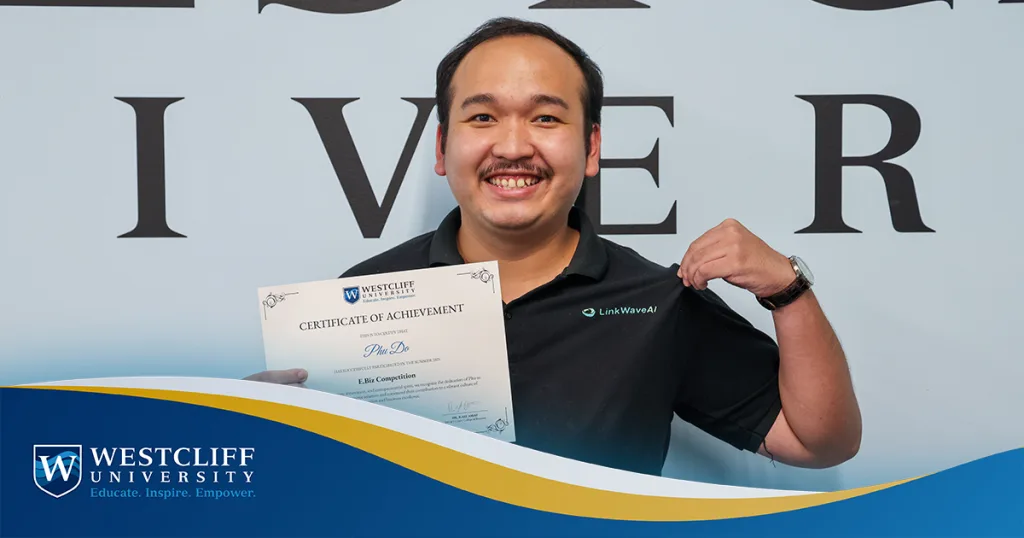
Phu Do’s six years of service in the United States Army gave him a clearer sense of who he is and what he wanted to build next. He could have followed the path that generations of his family had walked before him and made a career of military service. Instead, he chose to return to school, earn a master’s degree, and apply everything the Army had taught him to build something entirely his own.
Finding the right university was not a simple decision. Do was running his own contracting company, founding a tech startup and navigating the realities of civilian life after years in uniform. A traditional university schedule was never going to work. What he needed was an institution that could work around his life, support his transition and help him grow in the direction he was already heading.
“I could not go to a traditional school because I was running my own contracting company,” he said. “So I found Westcliff, which was the perfect match. Night school, where after work I can go to class and still take care of my personal things. It has been great.”
But to understand where he is going, it helps to understand where he came from.
Why He Chose to Serve
Military service was never abstract in the Do household. Phu Do’s grandfather fought during the Vietnam War, and the expectation that the men in his family would serve was as much a part of his upbringing as anything else. When Do came of age, enlisting felt less like a decision he made and more like one that had already been made for him.
“I decided to go to the military to continue my family traditions,” he said. “My grandfather fought during the Vietnam War, and it is a family tradition for the males to go into the military. I wanted to give back to this nation because of all the opportunities it has provided for me and for my family.”
Do brought that same conviction into everything he did in uniform, spending six years in the Army managing maintenance operations and the soldiers under his command, keeping equipment functional and teams sharp under conditions that reveal a person’s character more clearly than almost anything else.
When his service ended, he went back to something familiar. Before enlisting, Do had worked in construction, and returning to the industry felt like a natural next step. He started his own contracting company in Orange County and built a client base. The work was steady and the business was growing, but the deeper he got into the industry, the harder it became to ignore a problem that nobody seemed interested in fixing.
The Frustration That Became a Company
Running a contracting business in Orange County came with a frustration Do had not anticipated. The compliance process was a mess that had nothing to do with the quality of anyone’s work. Inspectors in the same city interpreted the same regulations differently. Architects were burning more than 30 percent of their time on paperwork when they should have been designing buildings. The industry had not meaningfully updated how it operated in decades, and yet everyone just kept moving through it like that was acceptable.
“It is 2026 and you still see people flipping through pages and reading plans,” he said. “It is not an efficient way to do it anymore. Imagine you are still using Windows 97. The construction industry is a legacy industry and it is so outdated. Everybody is interpreting different ways, different laws. Nobody really knows what is going on.”
Do stopped taking contracts and started asking a different question: what would it look like if the compliance infrastructure for construction permitting were unified and brought into the current century? The answer became Lingwave, a tech company he founded to build exactly that.
He was running Lingwave and managing the remaining threads of his contracting business when his mother called with a question that cut straight to the point.
“My mom called me and said, when are you going to get your master’s degree,” he said with a laugh. “With typical Asian traditions, it is a family tradition to get higher education. So that is where I found it.”
He started researching and found Westcliff. What he did not know yet was how much more the university had to offer beyond a schedule that worked.
What Westcliff Offered That Others Could Not
The flexible schedule was the entry point, but what kept Do engaged at Westcliff went well beyond what he saw on a website or brochure. The university’s veteran support infrastructure became a genuine anchor in his experience. Through the Innovation Hub, he competed in entrepreneurship competitions, built relationships with professors and connected with students who were building their own companies.
The e-biz challenge in particular became a defining moment. Do entered his company Lingwave and won first place, taking home a $3,000 seed grant, six months of incubation support from Westcliff mentors and a dedicated SMART MBA Capstone team to help grow the business. The competition gave Do the perspective to step back and make a significant pivot in his product direction, a decision he calls the smartest he ever made for Lingwave.
The veteran support was equally significant. Cristian Cabrera, Associate Director of Military and Veteran Affairs and a U.S. MarineCorp veteran himself, took a personal interest in Do’s journey from the moment he enrolled. Do does not describe him as a resource. He describes him as a mentor.
“The veteran department here is awesome,” Do said. “I could not say anything less than awesome about Cristian. He helped me a lot. He mentored me as well. He is very communicative and very understanding.”
That level of support reflects something deliberate about how Westcliff approaches military students. The university holds Military Friendly Gold Status, a designation that signals a sustained, institution-wide commitment to the men and women who have served. Westcliff accepts Post-9/11 GI Bill benefits, the Montgomery GI Bill, the Yellow Ribbon Program and Veteran Readiness and Employment benefits. Its admissions team actively guides military students through the documentation and certification process, and credit transfer options for Joint Services Transcripts mean that the training and experience earned in uniform carries real academic weight.
Do noticed the difference immediately. The administrative burden that derails so many veterans returning to school was simply not something he had to carry alone.
“I have a busy life,” he said. “And I can still achieve it while they take care of things for me. The faculty and the staff were taking care of pretty much everything that I needed to do.”
What He Would Tell the Veteran Who Is Still Deciding
Do is a few months from finishing his master’s degree and ready to give Lingwave his full attention. He knows what the transition from military service to graduate school actually looks and feels like from the inside, and he does not sugarcoat it for anyone who asks.
“Know your goal especially,” he said. “You might be able to get away with a general bachelor’s degree, but for your higher education, you have got to get it right. Because with the research you do now about what you really want to get into, if that master’s degree means something, do that. You do not want to waste your benefits and you do not want to waste your time. Transitioning out of the military into the civilian world and trying to go to school is a different vibe and a different environment. Things are not how they used to be. So do a lot of research about what you really want to do, about what you are passionate about. Do not just get a general degree. Get a specific degree. Have a plan.”
His advice to veterans who may not be ready for formal education yet is equally direct. Keep learning, he says, by any means available — YouTube, AI tools, conversations with people who know more than you do. In a world where entry-level jobs are increasingly at risk of automation, the only insurance is continuous growth.
His parting thought is short and says everything about how he approaches life.
“Do not stop your education. Do not stop your dedication. Continue improving. Try to learn something every day.”
What Westcliff Offers Military Students
Westcliff University’s Military and Veteran Admissions program is built around dedicated military advisors, flexible learning formats and a full range of education benefit options designed to make the transition from service to academia practical and well-supported. Credit transfer options for Joint Services Transcripts and military training mean veterans arrive with more than a fresh start — they arrive with credit for the experience they have already earned.
For veterans ready to take the next step, Westcliff’s team is ready to help them take it.
Learn more about Military and Veteran Admissions at Westcliff University.